

Airport Parking Systems
Off-airport parking is one of the most competitive segments in the parking industry. Travelers compare prices days before their trip, book online, and expect a seamless experience from the moment they pull into the lot until the shuttle drops them at the terminal. The operators who win that comparison are the ones running airport parking systems that automate entry, payment, reservations, and shuttle coordination — not the ones relying on toll booth attendants and handwritten receipts.
Parking BOXX designs and manufactures airport parking systems built specifically for the demands of off-airport lot operators. Every system combines barrier gate systems, parking pay stations, LPR cameras, and CloudEASE parking lot management software into a single integrated platform. Direct from the manufacturer, fully installed across North America. Parking Made Easy®.
Airport Parking Operations
Parking Professional covers airport parking operations in depth, including access control and revenue strategies specific to off-airport facilities.
Off-airport parking facilities face a unique set of operational pressures that surface lots and urban garages do not. Volume spikes are extreme and predictable — holiday weekends, spring break, and summer travel season can push a 1,000-space facility to capacity in a matter of hours. When every lane is backed up and travelers are watching the clock before a flight, the system either performs flawlessly or it creates the kind of bad experience that shows up in Google reviews within hours.
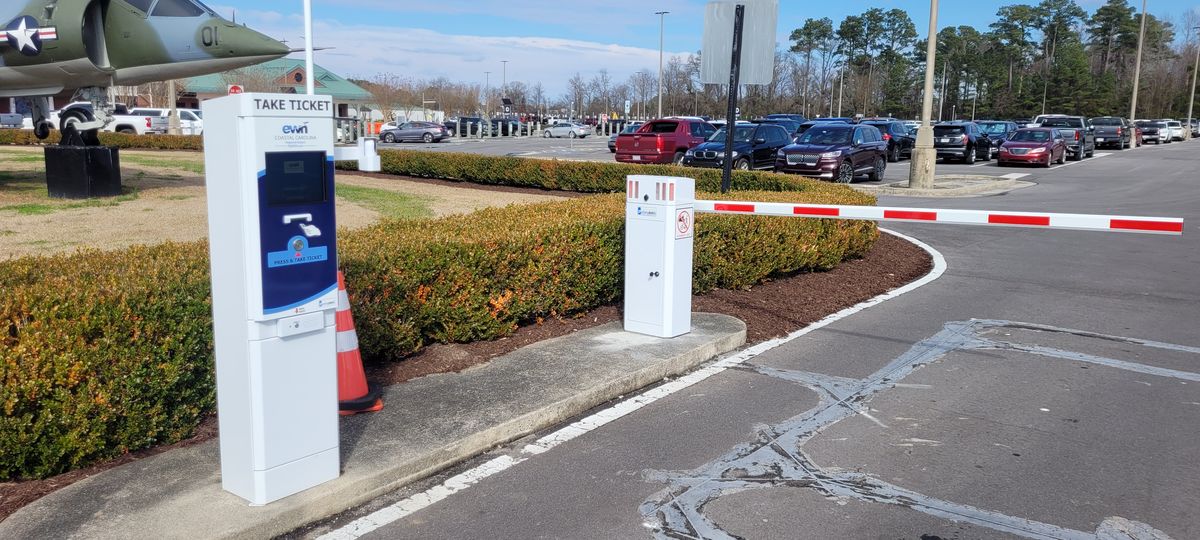
The entry lane is where most bottlenecks begin. A facility that still issues paper tickets and processes cash payments at exit forces every vehicle through a manual interaction. During a Monday morning rush, that interaction takes 15 to 30 seconds per vehicle. Multiply that across four entry lanes and 200 vehicles arriving between 4:00 AM and 7:00 AM, and the math breaks down fast. Automated entry — whether through ticket dispensers, pre-paid QR codes, or license plate recognition — eliminates the human bottleneck and keeps lanes flowing.
Shuttle coordination is the second operational challenge that separates professional off-airport operators from improvised ones. Travelers expect a shuttle within minutes of parking. If they wait 20 minutes in a lot while watching shuttles from a competing facility drive past, they will not return. Airport parking software that ties real-time occupancy data to shuttle dispatch gives operators the visibility to position buses where demand is building, not where it was 30 minutes ago.
Staffing is the third pressure point. Overnight shifts, early morning rushes, and weekend coverage create labor costs that eat into margins. Automated airport parking systems reduce the headcount required at entry and exit lanes, shift staff to higher-value roles like shuttle driving and customer service, and keep the facility running 24/7 without overtime.
Pre-Paid Reservations and Online Booking
Online reservations have become the standard booking method for airport parking. Travelers search for parking options days before their trip, compare prices across multiple facilities, and pre-pay for a guaranteed spot. The operator who shows up in that search with a professional booking experience, transparent pricing, and instant confirmation captures the reservation. The operator without an online presence loses the customer before they ever leave home.
CloudEASE supports a reservation workflow that connects the online booking to the physical parking system. A traveler selects their travel dates, chooses a lot tier — economy, premium, or covered — and completes payment. The system generates a confirmation that includes a QR code and ties the reservation to the traveler's license plate number. On arrival, the traveler either scans the QR code at the entry parking kiosk or simply drives up to the LPR camera, which reads the plate, matches it to the active reservation, and opens the barrier gate automatically. No ticket. No window interaction. No delay.
For operators, pre-paid reservations lock in revenue before the traveler arrives. This changes the financial profile of the business — a facility with 60% pre-paid bookings has predictable cash flow that can be forecasted weeks in advance. Reservation data also feeds capacity planning. When CloudEASE shows that covered parking is 90% reserved for a holiday weekend, the operator can close online sales for that tier, open overflow capacity, or adjust pricing dynamically to capture remaining demand at a premium.
Reservation management through CloudEASE also reduces no-show losses. Travelers who pre-pay are far more likely to show up than those who planned to pay on arrival. The system tracks no-show rates by booking channel, travel date, and lot tier, giving operators data to refine their overbooking strategy and cancellation policies.
Live carousel of Parking BOXX airport installations · loads from locations.parkingboxx.com
Multi-Lot Management for Airport Parking
Most off-airport operators run more than one lot. A typical facility near a major airport might include an economy surface lot, a premium close-in lot, and a covered garage — each with different pricing, different access rules, and different customer expectations. Managing three lots as three separate operations creates redundancy, inconsistency, and blind spots. Managing them from a single platform creates efficiency.
CloudEASE provides a multi-lot dashboard that shows real-time occupancy, revenue, and gate status for every lot from one login. The operator sees at a glance that the covered garage is at 85% capacity while the economy lot is at 40%, and can direct shuttle drivers, adjust pricing, or update the booking portal accordingly. Revenue reporting breaks down income by lot, by payment method, and by booking channel, so the operator knows exactly which tier and which channel delivers the highest margin.
Access rules differ by lot tier, and the parking system enforces them automatically. A traveler who booked economy parking receives a credential that opens the economy lot gate but not the premium gate. A VIP customer or loyalty member gains access to covered parking. These rules live in CloudEASE and apply at the gate without staff intervention, preventing unauthorized upgrades and protecting the revenue integrity of premium tiers.
For operators considering expansion — adding a new lot, converting a surface lot to structured parking, or acquiring a facility near a different airport — CloudEASE scales without replacing the core system. New lots connect to the existing dashboard, and the operator manages the entire portfolio from a single interface.
LPR for Airport Parking
License Plate Recognition transforms the entry and exit experience for airport parking. Instead of pulling a ticket, fumbling with a credential, or scanning a QR code, the traveler simply drives up to the lane. The LPR cameras mounted at the entry point read the plate in under one second, match it against the reservation database, and signal the barrier gate to open. The entire process takes less time than it takes to lower a car window.
For pre-registered travelers, LPR serves as the primary entry and exit layer. The plate number is the credential — the gate opens automatically, with no ticket to pull and no window to roll down. For travelers without a pre-registered plate, a backup ticket is dispensed so every vehicle has a path forward. At exit, the system matches the plate to the entry record, calculates any charges beyond the pre-paid amount, and processes payment automatically if a card is on file. Fully pre-paid travelers who stayed within the reservation window drive out without any interaction at all.
LPR also provides security and accountability benefits that matter in airport parking. Every plate is logged with a timestamp and lane identifier on entry and exit. If a vehicle is reported stolen or if there is a dispute about parking duration, the operator has a photographic record of the plate at both entry and exit. This data is stored in CloudEASE and searchable by plate number, date, or lot.
The parking barrier gate for airport parking must cycle fast enough to keep up with LPR-speed entry. Parking BOXX barrier gates are engineered for high-cycle operations with arm rise times under 1.5 seconds, matching the speed of LPR identification so vehicles do not stack in the lane waiting for the gate to open.
Airport Parking Revenue Optimization
Revenue optimization at an off-airport facility goes beyond setting a daily rate and collecting payment. The operators who maximize revenue per space treat pricing as a dynamic variable that responds to demand, seasonality, competition, and booking channel.
Dynamic pricing adjusts rates based on occupancy and advance booking window. A traveler booking covered parking three weeks before a holiday weekend pays a lower rate than one booking two days out when availability is tight. CloudEASE supports rule-based pricing tiers that adjust automatically as occupancy thresholds are reached — no manual intervention required.
Seasonal pricing captures the predictable demand swings in airport parking. Summer travel, Thanksgiving, Christmas, and spring break each produce peak demand that justifies premium rates. Off-peak periods — January through February, mid-September through October — call for promotional pricing or bundled deals that keep occupancy above breakeven. CloudEASE reporting shows historical revenue by week, enabling operators to build pricing calendars based on actual demand data rather than guesswork.
Early-bird and length-of-stay discounts incentivize behaviors that benefit the operator. A traveler who books 14 days in advance and commits to a 7-day stay provides guaranteed revenue and predictable capacity. Offering a modest discount for that commitment still yields higher total revenue per space than a walk-up customer who stays two days at the full rate.
Ancillary revenue adds margin without adding spaces. Car detailing, EV charging, luggage wrapping, and rental car partnerships all generate per-vehicle income on top of parking fees. CloudEASE tracks ancillary revenue alongside parking revenue, giving operators a complete picture of per-vehicle yield.
Use the Parking BOXX parking revenue calculator to estimate what optimized pricing and automated payment collection could return at your facility.
Barrier Gates for Airport Parking
Barrier gates are the physical enforcement layer of every airport parking system. They control who enters, who exits, and when — 24 hours a day, 365 days a year. At an off-airport facility where the parking system runs without breaks, gate reliability is not a feature; it is a requirement.
Parking BOXX barrier gate systems are built for continuous-duty operation. Arm lengths up to 20 feet accommodate wide lanes and dual-direction configurations. Fast cycle times — arm up in under 1.5 seconds — keep vehicles moving through entry and exit lanes during peak hours. Anti-crush safety sensors detect vehicles and pedestrians in the gate path and prevent the arm from lowering until the lane is clear.
For airport parking facilities, the consequences of a gate failure are immediate and visible. A jammed entry gate during a Monday morning rush creates a line of anxious travelers who cannot afford to miss a flight. A stuck exit gate traps vehicles in the lot and overwhelms staff with manual overrides. Parking BOXX gates are engineered with redundant motor systems and battery backup to maintain operation during power interruptions — the scenarios where reliability matters most.
Gate integration with the rest of the parking system is what turns hardware into a managed operation. Every gate event — open, close, error, manual override — is logged in CloudEASE with a timestamp. Operators see gate health status in real time and receive alerts for any anomaly before it becomes a customer-facing problem. Preventive maintenance schedules based on cycle count data reduce unplanned downtime and extend gate lifespan.
Frequently Asked Questions
What is an airport parking management system?
How does LPR work for airport parking?
Can travelers reserve airport parking online?
What is the ROI of an airport parking system?
How do off-airport lots handle shuttle coordination?
What equipment does an airport parking lot need?
How do airport parking systems handle complex rate structures?
What is the difference between airport terminal parking and off-airport parking systems?
What payment methods do airport parking systems accept?
Can airport parking systems generate revenue reports for airport authorities?
Get an Airport Parking System Quote
Parking BOXX manufactures, installs, and supports airport parking systems across North America. Whether your off-airport facility needs a single-lot entry and exit solution, a multi-tier reservation platform, or a full LPR and parking management systems deployment, every component is built by Parking BOXX — direct from the manufacturer, with no middlemen. Learn more about parking control systems from Parking BOXX.